
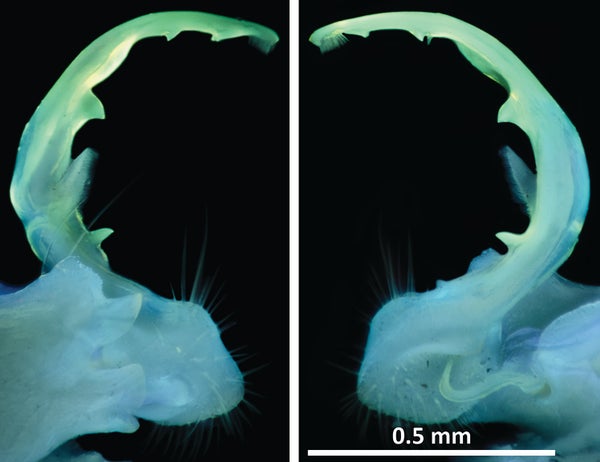
Millipedes are hard to tell apart. Different species of the many-legged creatures often share the same dull colors and tend to blend in with the gloom of the forest floor. But under ultraviolet light, some millipedes display a striking characteristic: their genitals glow brightly.
Stephanie Ware, a research assistant at Chicago’s Field Museum, and her colleagues have used this strange fluorescence to help identify the leggy arthropods. Ware rigged up a camera with inexpensive UV flashlights to capture images of millipedes’ glimmering “gonopods,” specialized appendages used for copulation. The camera took multiple pictures that Ware stitched together to create a composite image. In visible-light photographs, “it’s really hard to pick out different structures” on the millipedes, she says. “But under UV, there were different patterns and colors that made them really pop out.”
This technique makes it easier to distinguish between similar-looking species, according to Petra Sierwald, a zoologist at the Field Museum She and Ware and their colleagues co-authored a study on the topic, published online in April in the Zoological Journal of the Linnean Society. Using the UV technique, the researchers identified eight species—which had previously been miscategorized as 12—within the North American genus Pseudopolydesmus. Sierwald says this kind of imaging could have applications in soil science and conservation, helping researchers quickly assess whether certain millipede species are present in a habitat. “Millipedes are very good indicators for soil health because they recycle rotting leaf litter,” she says.
On supporting science journalism
If you're enjoying this article, consider supporting our award-winning journalism by subscribing. By purchasing a subscription you are helping to ensure the future of impactful stories about the discoveries and ideas shaping our world today.
Yet scientists still have no idea why these animals’ genitals fluoresce. “The order Polydesmida can’t even see—they don’t have eyes,” Sierwald says. M. Gabriela Lagorio, a chemist who studies photobiology at the University of Buenos Aires and was not involved in the study, says the feature may or may not have an evolutionary purpose. She notes that it may be “simply a nonfunctional consequence of the chemical structure of a substance present in the tissue.”